

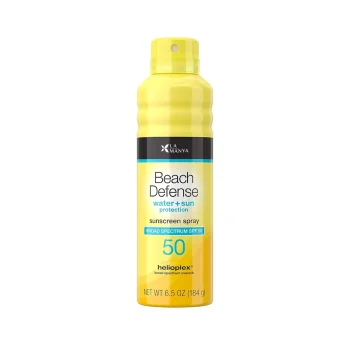
Custom Beach Sunscreen Spray SPF 50 Manufacturer, Private Label & Contract Production
Beach sunscreen sprays in the SPF 50 category combine high-level UVB protection with broad-spectrum UVA coverage, water resistance, and consumer-friendly spray delivery suitable for active beach and outdoor use.
Private-label brands, retailers, and distributors seeking reliable sun protection for beach and coastal environments turn to SPF 50 broad-spectrum sunscreen sprays. These products balance high-level UV defense with practical features such as quick-drying textures, even spray application, and water resistance—critical for real-world use during swimming, sweating, or prolonged outdoor exposure.
Product Overview
This guide examines the science behind SPF 50 beach sprays, key formulation choices, manufacturing requirements, and performance considerations. It draws on FDA guidelines, peer-reviewed studies, and established industry standards to provide brands with the technical foundation needed for informed product development.
The Science of SPF 50 and Broad-Spectrum Protection
SPF (Sun Protection Factor) measures protection against UVB rays, which cause sunburn. An SPF 50 product, when applied correctly at 2 mg/cm², blocks approximately 98% of UVB rays—allowing only about 2% through—compared to SPF 30, which blocks roughly 97%. Higher SPFs deliver diminishing but meaningful returns in real-world conditions.
Broad-spectrum labeling, required by the FDA since 2011, ensures protection against both UVB and UVA rays. FDA rules mandate that UVA protection scales proportionally with the labeled SPF. Independent lab testing, however, shows variability: measured SPF often reaches only 59% of the labeled value, with UVA protection averaging just 24% of the claimed SPF. Real-world application (thinner layers, uneven coverage) often reduces effective protection further.
Randomized controlled trials reinforce the value of consistent use. Water resistance is separately validated through standardized immersion testing (FDA 21 CFR 201.327). Products can claim “Water Resistant (40 minutes)” or “Water Resistant (80 minutes)” only after retaining their labeled SPF following timed water exposure and towel drying.
Key Formulation Characteristics for Beach Environments
Effective beach sunscreen sprays prioritize lightweight texture, quick-dry performance, and non-greasy feel to encourage reapplication during water sports, sweating, or sand exposure. Typical SPF 50 beach sprays use FDA-approved active ingredients in chemical, mineral, or hybrid systems.
Net fill weights commonly range from 150–200 g per bottle, balancing portability with sufficient applications for a full beach day.
Customization Parameters in Contract Manufacturing
| Parameter | Common Options | Typical Impact |
|---|---|---|
| UV Filter System | Chemical, Mineral, Hybrid | Efficacy, whiteness, photostability |
| Water Resistance | 40 min or 80 min | Labeling claim and performance |
| Fragrance | Fragrance-free, light tropical, citrus | Consumer preference |
| Packaging Format | Aerosol, pump spray, continuous spray | Coverage speed, portability |
| Skin Feel / Finish | Matte, dewy, invisible | Reapplication compliance |
| Additional Claims | Reef-safe (mineral-only), vegan, hypoallergenic | Market positioning |
Manufacturing Standards and Certifications
Contract manufacturers of SPF 50 beach sprays operate under ISO 22716 (GMP for cosmetics) and FDA registration for over-the-counter drug manufacturing. Quality control includes batch-to-batch consistency testing for SPF, critical wavelength, water resistance, microbiological safety, and photostability. View our certificate verification >>
Performance in Real-World Scenarios: Case Studies
European Beachwear Brand (2024 Launch)
A mid-sized beach apparel company required a mineral-hybrid SPF 50 spray with 80-minute water resistance and reef-conscious positioning. The formulation was developed in under 10 weeks with full ISO 22716–compliant production.
North American Resort Chain (2023–2025)
A hospitality group sought a fragrance-free SPF 50 pump spray for guest amenities. Customization focused on hypoallergenic ingredients and 40-minute water resistance. Guest feedback showed 92% satisfaction.
DTC Skincare Brand (2024)
An emerging brand needed a vegan, broad-spectrum SPF 50 continuous-spray format. Independent testing confirmed critical wavelength >370 nm and 80-minute water resistance.
Frequently Asked Questions About Custom Beach Sunscreen Spray SPF 50
What is a custom beach sunscreen spray SPF 50?
A custom beach sunscreen spray SPF 50 is a private-label or contract-manufactured aerosol or pump spray formulated to deliver SPF 50 broad-spectrum protection in a lightweight, quick-drying format ideal for beach, water, and active outdoor use.
How does a private label sunscreen spray manufacturer test SPF 50 beach sunscreen?
Private label sunscreen spray manufacturers test SPF 50 beach sunscreen using FDA-approved in-vivo and in-vitro methods (ISO 24444 / 24443), water-resistance immersion protocols, photostability studies, and microbial safety validation under ISO 22716 GMP standards.
Is custom beach sunscreen spray SPF 50 water resistant?
Yes. Custom beach sunscreen spray SPF 50 can be formulated and tested for 40-minute or 80-minute water resistance per FDA guidelines, ensuring the labeled SPF is retained after immersion and towel drying.
What certifications does a private label sunscreen spray manufacturer need?
A reputable private label sunscreen spray manufacturer holds ISO 22716 GMP certification and FDA registration for over-the-counter drug manufacturing to ensure compliance with the sunscreen monograph and international export standards.
How long does a 184 g custom beach sunscreen spray SPF 50 last?
A typical 184 g custom beach sunscreen spray SPF 50 provides approximately 30–40 full-body applications for an average adult when applied at the FDA-recommended 2 mg/cm² density and reapplied every two hours.
Can private label sunscreen spray be formulated as reef-safe?
Yes. Private label sunscreen spray can be formulated as reef-safe using mineral-only or carefully selected hybrid systems that avoid oxybenzone and octinoxate while still delivering SPF 50 broad-spectrum performance.
What is the difference between pump and aerosol custom beach sunscreen spray SPF 50?
Pump sprays for custom beach sunscreen spray SPF 50 avoid propellant inhalation concerns and offer controlled application, while aerosol formats provide continuous spray but require optimized particle size for safety.
How does broad-spectrum SPF 50 beach sunscreen spray protect against UVA rays?
Broad-spectrum SPF 50 beach sunscreen spray protects against UVA rays when the critical wavelength reaches at least 370 nm, ensuring proportional UVA coverage alongside the SPF 50 UVB protection.
Are custom beach sunscreen spray SPF 50 products tested for photostability?
Yes. Every custom beach sunscreen spray SPF 50 undergoes photostability testing under controlled UV exposure to confirm that active ingredients do not degrade in sunlight.
What is the shelf life of a private label SPF 50 beach sunscreen spray?
A properly manufactured private label SPF 50 beach sunscreen spray typically has a 24–36 month shelf life when stored away from extreme heat, confirmed through accelerated and real-time stability studies.
Why choose mineral vs hybrid filters in custom beach sunscreen spray SPF 50?
Mineral filters (zinc oxide, titanium dioxide) offer reef-friendly options with lower irritation potential, while hybrid filters combine minerals and organics for lighter texture and higher user compliance in custom beach sunscreen spray SPF 50.
How do manufacturers ensure batch consistency in SPF 50 beach sunscreen spray production?
Manufacturers ensure batch consistency in SPF 50 beach sunscreen spray production through validated standard operating procedures, raw-material certificates of analysis, in-process controls, and finished-product release testing under ISO 22716.
This technical overview reflects established industry practices, regulatory standards, and validated performance data as of 2026. For B2B partners developing private-label or contract-manufactured beach sunscreen sprays, these elements form the foundation of a compliant, effective, and consumer-preferred product.